
The British, Irish-born painter Francis Bacon is one among the most important painters of the 20th century. Bacon was born in Dublin on 28 October 1909 to English parents who have recently moved to Ireland. His family moved between England and Ireland in the post war years, but his homelife became strained as he entered puberty and began to realize his homosexuality. In 1926, after being thrown out of the family home, the 16 year old Bacon arrived in London with little money and no clear plan. The following year, he travelled to Berlin and Paris - there he saw Pablo Picasso’s 1927’s exhibition which deeply impressed him. Toward the end of 1928 Bacon returned to London, where he worked as a furniture and interior designer. He began exhibiting some of his designs in studio shows with painters Jean Shepeard and Roy de Maistre. Bacon also met one of his early patrons, businessman Eric Hall, with whom he had an intimate relationship that lasted over 15 years. Bacon began to shift his energies toward painting, and in 1933 he produced his first significant painting Crucifixion (1933), that shows the influence of Picasso and his biomorphic forms.
Despite some modest success, Bacon struggled to live from his work. He also grew dissatisfied with his early works, and destroyed most of the paintings from the period. At the outset of World War II, Bacon was exempt from military service because of his asthma, but he volunteered for Civil Duty, where he worked in Air Raid Precautions until 1943. This period was also artistically formative for Bacon - paintings from the period like Three Studies for Figures at the Base of a Crucifixion (1944) propelled him to the center of London’s post-war art scene. In 1948, Bacon enjoyed a career milestone when the Museum of Modern Art in New York acquired Painting (1946). During this time, Bacon created some of his most recognized and important works, the Head series (1949), and began his series of screaming Popes that were largely inspired by Diego Velazquez’s Portrait of Pope Innocent X (1650). After his long engagement with the Pope series, Bacon presented a series inspired by Vincent Van Gogh’s painting The Painter on the Road to Tarascon (1888). Paintings like Study for a Portrait of Van Gogh I (1957) represent a clear break from the artist’s previous monochromatic paintings.
In 1961, Bacon settled in South Kensington, London, where he remained for the rest of his life. Paintings from the period like Three Studies for a Crucifixion (1962) were large scale triptychs, a popular format that is in Bacon’s body of work. In 1963, Bacon’s retrospective opened at The Solomon R. Guggenheim Museum in New York further solidifying his international status. Years later in 1971, at the opening of his large retrospective in Paris, he learned of the suicide of friend and former lover George Dyer. Many subsequent paintings were dedicated to the subject such as Triptych March 1974 (1974). Throughout the 1980s, Bacon was internationally recognized with a Tate retrospective in 1985 and international showings in Moscow (1988) and Washington (1989). Francis Bacon died of pneumonia on April 28th 1992 while on a visit to Madrid.
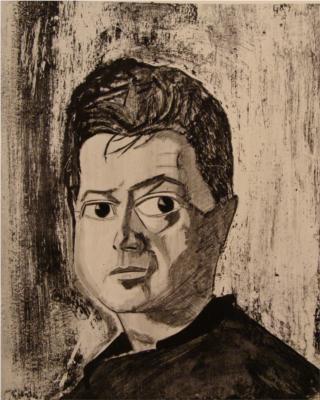
Francis Baco, one of the most influential artists of the 20th century
Veselin Nikolov
Посещения: 0